About Me

My photo
Bhavnagar, Gujarat, India
Hello friends..!! I'm Gopi Dervaliya, a student of English Literature, pursuing M.A from Department of English, Maharaja Krishnakumarsinhji Bhavnagar University.I've completed graduation from Gandhi Mahila College,S.N.D.T Women's University, Bhavnagar and I've also completed B.ed from District Institute of Teachers Education and Training Center(DIET),Sidsar, Bhavnagar. My all blogs are about English literature and language.

Saturday, 18 November 2023

Youth Festival 2023

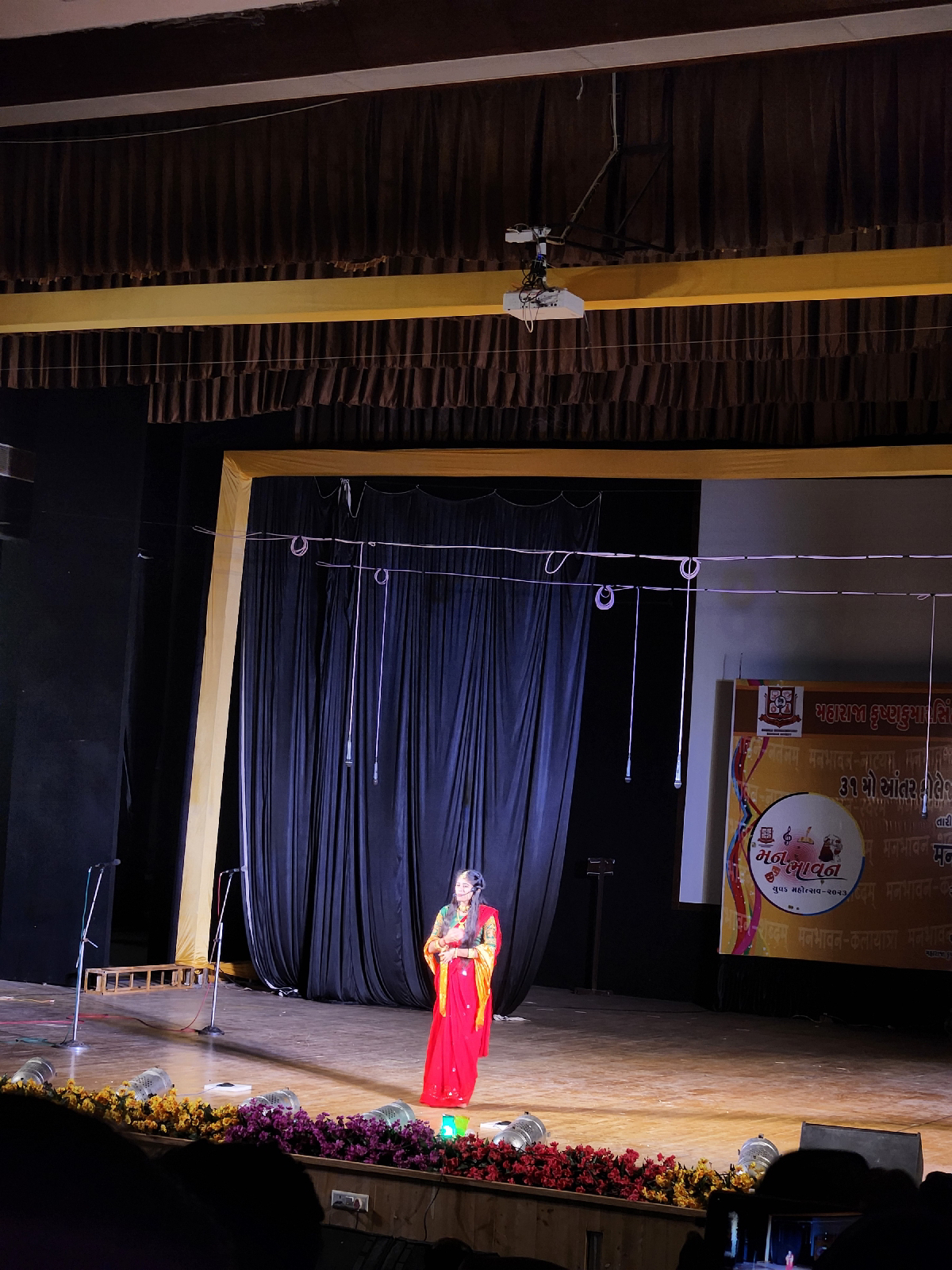
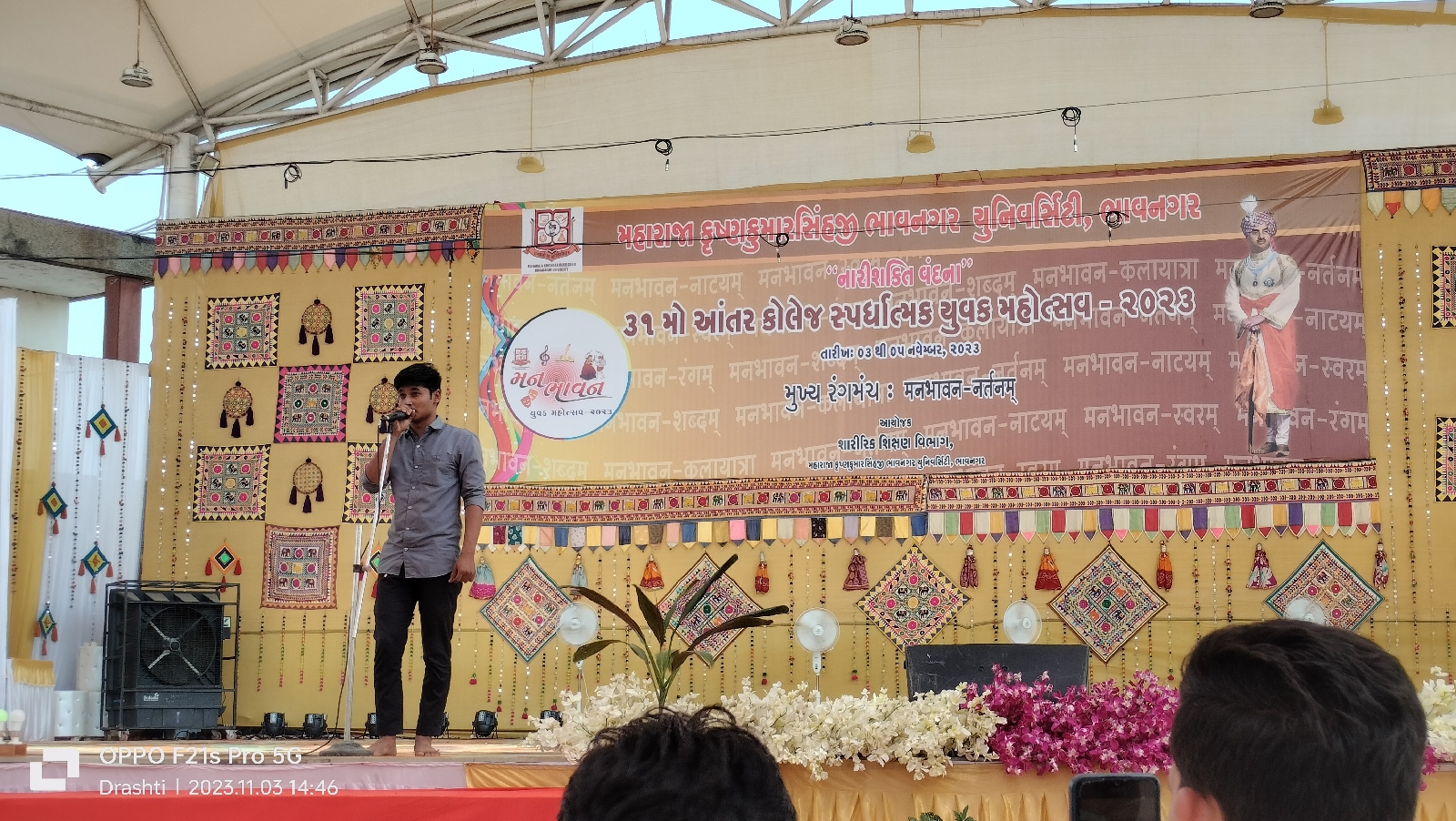
Hello everyone, I'm writing this blog on a wonderful event of Maharaja Krishnakumarsinhji Bhavnagar University, which is the 31st Inter College Youth Festival 2023. This year's Youth Festival is organized by the Department of Physical Education. The title of the youth festival is 'Man Bhavan Yuvak Mahotsav -2023' and the theme of the youth festival is 'Nari Shakti Vandana'. This Youth Festival is held on 3 days, 3 to 5th November. Different competitions were organized on the first 2 days and the result was announced on the last day.


So, first we will discuss the Kala Yatra, Which was from Shamaldas Arts College to J.K. Sarvaiya Group of College at 4 pm on 2nd November. In this Kala Yatra, all colleges with different themes, like technology, women empowerment, Chandrayaan 3 etc. All colleges gave very good performances with different themes. Our Department went to Kala Yatra with the theme male dominance and women empowerment. 

The route of Kala Yatra

• Shamaldas Arts College, 

• Central Salt, 

• Aatabhai Chowk, 

• Rupani Circle, 

• Sardarnagar, 

• Swaminarayan Gurukul, 

• J.K. Sarvaiya Group of College 

Here are some glimpse of Kala Yatra,

The theme of women empowerment was presented in kala yatra from our department in which I did face painting of few students. Which was a very good experience for me.

An opening ceremony was held at the Amphitheater on 3rd November. After that all competitions started. 

Here is list of guests who were presented in Youth Festival in Kala Yatra, Opening ceremony and Closing ceremony.

There were 5 stages :

• Amphitheater (Mukhya Manch)

In which various events like, Folksong, Mimicry, Western Solo, Western Group Song, Folk Dance, Lokvadhyavrind, Group Song etc. were organized. 

• Atal Auditorium (Natya Manch)

In which various theatre events like, Skit, One act play, Classical dance, Monologue and Mime, were organized.

• New Court Hall

In which Bhajan, Sugam geet, Classical singing, Elocution, Classical music (Percussion instrument) and Classical music (Vocal instrument) were organized.

• External Department

In which organised all Art events like, On the spot painting, Collage, On the spot photography, Clay modelling, Mahendi, Cartooning, Poster making, Rangoli and Installation. 

• English Department

In which Quiz (Preliminary & Final), Poem reading and essay competitions were organised. 


So let's start this blog with the most interesting and my favorite 'Theater events'.

Theatre events :

• Skit :

In theatre, a "skit" refers to a short, humorous play or performance, often improvised or scripted with minimal dialogue. Skits are typically brief and aim to entertain through comedy or satire, making them a popular form of entertainment in various settings.

In which many colleges were participating with different themes. I watched the whole event and here I try to give complete information including the college code and the themes presented by that team.

College code 1:

Themes : Mobile, technology, social media

College code 2:

Themes : Gaddar 2, Indian great scientist, Women empowerment

College code 17 :

Themes : Swachata, Chandrayaan 3

College code 19:

Theme : Superstitions


College code 24:

Themes : Bhavnagar road management, BMC

College code 34:

Themes : 'Dada ni Vaato', Bhavnagar culture


College code 38 :

Theme : 'Man no avaj'


College code 40:

Themes : Vande bharata, G20, Road construction

College code 41:

Themes : Development and Wealth, Swachhata


College code 52:

Themes :  MonghvariSocial mediaAndekhaSannata

College code 53:

Theme : 'Show India ka'


• One Act Play :

A One Act Play is a complete play with a single, continuous storyline that is performed in one act or without an intermission. Unlike full-length plays, which may have multiple acts, one-act plays are designed to be performed in a single stretch. They often focus on a specific theme, idea, or situation, delivering a concise and powerful theatrical experience within a shorter time frame.

Here are some performance of One act play which were performed by colleges :


• Classical Dance :

Classical dance refers to a traditional form of dance that has its roots in a particular culture, often with a long history and established techniques. These dance forms have a set vocabulary of movements, positions, and gestures. Classical dances are often characterized by their precise and intricate footwork, hand gestures, facial expressions, and elaborate costumes. Examples of classical dance styles include Bharatanatyam and Kathak from India.

Here are some performance of Classical dance which were performed by colleges :

• Monologue :

In theatre, a monologue is a speech or a long passage spoken by one character without interruption from others. It's a moment when a character expresses their thoughts, emotions, or experiences directly to the audience or other characters. Monologues can serve various purposes, such as revealing a character's inner thoughts, providing background information, or advancing the plot. They are a powerful tool for actors to showcase their skills and for playwrights to convey important elements of the story. Monologues can be found in a wide range of theatrical genres, from dramas to comedies.

Pooja Bhuwa from our department participated in the Monologue and performed very well.


Here are some performance of Monologue which were performed by colleges :


• Mime :

Mime in theatre refers to a form of performance art where actors use physical movement and gestures to convey a story, character, or idea without the use of spoken words. Miming often involves exaggerated and expressive body movements, facial expressions, and gestures to communicate with the audience. Mime performances are highly visual and rely on the actor's ability to convey meaning through non-verbal communication.

All the colleges in mime gave a very good performance and passed a very good message. Here are some performance of Mime which were performed by colleges :

• Mimicry :

Mimicry, in a theatrical context, typically refers to the skill of imitating or copying the mannerisms, voices, or behaviors of others. It can be a form of performance art where an actor or performer mimics the characteristics of a specific person, often for comedic effect or as part of an impersonation act. Mimicry may involve replicating accents, speech patterns, physical gestures, and facial expressions to create a recognizable and entertaining portrayal of the person being mimicked. While mime focuses on non-verbal communication through physical actions, mimicry often involves the imitation of vocal and behavioral aspects.

Jay Solanki from our college participated in Mimicry and gave a very good performance.

Here are some performance of Mimicry which were performed by colleges :

These all theatre events were organised at Atal auditorium.

Now it's turn to Amphi theatre's events :

• Folk song :

A folk song is a traditional song that has been passed down through generations within a particular community or culture. These songs often reflect the experiences, customs, and values of the people from whom they originate. Folk songs are typically transmitted orally and may evolve over time as they are shared within communities. They cover a wide range of themes, including love, work, historical events, and storytelling. 

• Folk Dance :

It refers to traditional dances that have originated and evolved within the cultural and social traditions of a specific region or community. Folk dances often reflect the history, rituals, and daily life of the people who perform them. These dances are usually passed down from generation to generation and are characterized by distinctive steps, movements, and music. 
• Western group and solo song :

Western group song in a performance context likely refers to a musical performance where a group of individuals collaboratively sings a song from a Western music genre. Western music encompasses various genres such as rock, pop, country, jazz, and more.

Here some glimpses of New court hall's events : 

• Sugam geet :

Sugam Sangeet is a term in Indian music that translates to "easy" or "pleasing" music. It refers to a genre of popular and accessible songs that are characterized by melodious tunes and simple lyrics. Sugam Sangeet is often associated with light music and is more easily understandable and enjoyable for a wide audience. This genre includes a variety of songs, often focusing on themes such as love, emotions, and everyday life.

Hardi from our department participated in Sugam geet and gave a good performance.


• Bhajan :

A Bhajan is a devotional song, typically expressing love and reverence for a deity in Hinduism. These songs are a form of religious music and are often sung in praise of gods, goddesses, or spiritual themes. Bhajans can be traditional or composed more recently, and they are an integral part of religious ceremonies, festivals, and devotional practices in Hindu culture.

Rinkal Danger from our department participated in Bhajan and she gave very nice performance.

• Elocution :

Elocution refers to the skill of clear and expressive speech, often with a focus on pronunciation, articulation, and vocal delivery. It is the art of effective and persuasive public speaking or the study of formal speaking in pronunciation, grammar, style, and tone. Elocutionists aim to communicate their message clearly and convincingly, paying attention to aspects such as voice modulation, intonation, and appropriate gestures.

Subjects :

• 'આર્ટિફિશિયલ ઇન્ટેલિજન્સ: કેટલું પડકારજનક?'    
• 'યત્ર નર્યાત્સુ પૂજ્યંતે'    
• 'ચાલો વૃધ્ધાશ્રમ ઘટાડીએ'    
• 'પર્યાવરણ અને માનવ: એક સિક્કાની બે બાજુ'   
•'Global Terrorism: Implications and Solutions' 
• 'વૈશ્વિક આતંકવાદ: અસરો અને ઉકેલો'     
• 'बुलंद भारत की बुलंद तसवीर'

Trushali Dodiya from our department participated in Elocution and gave a wonderful performance.

Here are some performance of External department's events :

• On the spot painting :

On the spot painting typically refers to a form of artistic expression where an artist creates a painting spontaneously and within a limited time frame, often in a live or public setting. The artist doesn't have the luxury of extended preparation or planning and instead relies on their creativity and skill to produce a piece of art in the moment. 

Subjects :

• 'ઉત્સવોની ઉજવણી'    
• 'નારીશક્તી'  
 
Heena Parmar from our department participated in On the spot painting and she gave a very nice performance.


• Paper Collage :

A collage is a technique where various materials such as paper, fabric, photographs, and other found objects are combined and assembled to create a new composition. Collages can take on various forms, from abstract and surreal compositions to more representational or narrative works. 

Subjects : 

• 'Fish tank'

• 'Flowerpot' 

• 'Rainy Season'    

Reshma Bilakhiya from our department participated in Paper collage and she gave a good performance.

• Clay modelling :

Clay modeling is a form of sculpting that involves shaping and manipulating clay to create three-dimensional objects or sculptures. Artists use their hands and various tools to mold the clay into the desired form. The clay used for modeling can be natural clay that air-dries or is fired in a kiln, or it can be oil-based clay that remains pliable and doesn't dry out.

Rajeshvari Rana from our department participated in Clay modelling and she also gave an amazing performance.

Subjects : 

• Cartooning :

Cartooning in art refers to the creation of humorous or satirical illustrations, often in a simplified and exaggerated style. Cartoons can take various forms, including single-panel cartoons, comic strips, and editorial cartoons. Cartoonists use a combination of images and text to convey a message, tell a story, or evoke humor.

Cartooning often involves the use of simplified and stylized characters, along with bold lines and vibrant colors. Cartoonists may address a wide range of subjects, from everyday life and social commentary to political satire. 

Subjects :

• 'મોંઘવારી'     
• 'ચૂંટણી'     
• 'ગાંધીજી અને જનતા'

Dhatri Parmar from our department participated in Cartooning and she gave a very good performance and also she secured 2nd rank in cartooning and this is a very good thing for our department.

• Poster Making :

Poster making in art refers to the creation of visual compositions designed for public display. Posters are often used for advertising, promoting events, conveying information, or advocating a particular cause. The process of poster making involves conceptualizing the message, selecting appropriate visuals, arranging text, and ensuring overall visual appeal. Posters can be created using traditional art techniques, digital illustration software, or a combination of both. Effective poster design captures attention, communicates a message clearly, and conveys the intended information or emotion to the audience.

Subjects :

• 'વૃધ્ધની સેવા'    
• 'પાણી બચાવો'    
• 'કન્યા શિક્ષણ'

Heena Parmar participated in Poster making and she gave a very good performance.

• Rangoli :

Rangoli is a traditional Indian art form where intricate and colorful patterns are created on the ground, typically in courtyards, living rooms, or entrances, using materials like colored rice, dry flour, colored sand, or flower petals. These designs are often created during festivals, special occasions, or celebrations.

Trushali Dodiya from our department participated in Rangoli and she secured 2nd rank.

• Installation : 

In the context of art, an "installation" refers to a form of contemporary art where the artist creates an entire environment or a specific arrangement of objects within a space. Installations often go beyond traditional art forms and may include a combination of various media such as sculpture, found objects and other elements to create a multisensory experience.

In this Installation, there were only 4 students participated and made a team for installation and from our department,

Bhavyata Kukadiya

Rajeshvari Rana

Pooja Bhuva

Drashti Joshi

They participated and gave wonderful performances.

Subjects :

• 'નારીશક્તિ'
• 'સુરક્ષા'
• 'મજૂર'
• 'ચિકિત્સા (આયુર્વેદના સંદર્ભમાં)'

• Photography  :  

Bhoomi Gohil from our department participated in Photography and she gave a very good performance.

Subjects :

'યુવક મહોત્સવ 2023'
• 'આજની નારી' 
• 'કુદરતની સંગાથે' 

Some events of English Department : 

• Poetry Writing :

Upasana Goswami form our department participated in Poetry writing and she performed very well.

Subjects :

• 'ઉમ્મીદ' 
• 'બાળપણ ખોવાણું'
• 'સ્મરણોની કેડીએ' 
• 'જે કર જૂલાવે પારણું'
• 'मेरी मिट्टी मेरा देश' 


• Essay Writing :

 Insiyafatema Alvani from our department participated in Essay writing and she gave a very good performance. 

Subjects :

• 'India's Space Odyssey' 
• 'From the Kitchen to Cabinet - Women, Don't Give Up'
• 'Are Wars Inevitable?'
• 'The Importance of Value based Education' 
• 'Plastic Pollution - Problems & Resolution' 


• Live streaming link :

     All these events were broadcasted live on YouTube and Facebook for 3 days. Here are some links of YouTube channel through which you can watch all events.


Kala Yatra :


Opening ceremony :


One Act Play :

Day 1 :


Day 2 :


Monologue :


Skit :


Mime :


Group song Indian :


Lokvadhyavrind :


Classical dance :


Western group-solo song :


Folk song :


Sugam geet :


Bhajan :


Mimicry :


Folk dance :


Closing ceremony & results :

• Newspaper Cuttings :

The title of Yuvak Mohotsav Manbhavan Yuvak Mohotsav 2023 has indeed proved true. Various colleges participated in this 3-day youth festival and mesmerized the audience. Some information of which was also reported in the news.


We learned a lot in this youth festival which we will never forget. All the colleges performed very well and the hard work of the students could be seen in all the competitions. And secondly, volunteers have a great contribution in this youth festival. Who worked very hard. The students who have participated and the volunteers were also provided with food. The facility of free rickshaws was also available throughout the University for wherever one wanted to go.


Thank you for visiting my blog...


Monday, 6 November 2023

Cultural Studies in practice : Unit 3-4

Hello everyone, I'm writing this blog as a thinking activity. Here, I will try to explain my understanding of Cultural Studies in practice. I will try to write about the approach of Cultural Studies applied in the reading of the play 'Hamlet', poem 'To his coy mistress' and novel 'Frankenstein'.

'Hamlet' by William Shakespeare :

Cultural Studies, as an interdisciplinary field, provides a unique lens through which to analyze literary works like William Shakespeare's 'Hamlet.' By examining the play through a Cultural Studies approach, we can uncover hidden layers of meaning, contextualize its themes within their historical and social settings, and explore how 'Hamlet' reflects and shapes cultural norms and values.

First and foremost, Cultural Studies emphasizes the importance of context. 'Hamlet' was written in the early 17th century, a time of political upheaval and social change in England. By delving into the historical context, we can better understand the power struggles, religious conflicts, and social hierarchies that permeate the play. Cultural Studies invites us to examine how these contextual factors influenced Shakespeare's portrayal of power dynamics, the monarchy, and the role of women in society.

Additionally, Cultural Studies recognizes the role of ideology in shaping narratives. 'Hamlet' is rich with ideologies related to monarchy, family, and gender. Cultural Studies allows us to analyze how these ideologies are presented and reinforced or challenged within the play. For example, the concept of divine right and the legitimacy of monarchs are central themes in 'Hamlet.' A Cultural Studies approach prompts us to explore how these ideas were not only depicted in the play but also how they might have reflected or influenced the prevailing political ideologies of the time.

Furthermore, Cultural Studies encourages us to consider how 'Hamlet' participates in a larger cultural discourse. The play's treatment of madness, revenge, and moral ambiguity speaks to broader cultural concerns and debates of its time. By examining how 'Hamlet' fits into the cultural milieu of the Elizabethan era, we gain insight into how the play may have contributed to or challenged dominant cultural narratives.

The characters in 'Hamlet' also offer opportunities for cultural analysis. For instance, Ophelia, Hamlet's love interest, can be studied through a gendered lens. Cultural Studies prompts us to consider how Ophelia's portrayal reflects societal expectations for women in the early 17th century. Her descent into madness and eventual demise can be seen as a commentary on the limitations and pressures placed on women in that historical context.

Cultural Studies also emphasizes the importance of reception and interpretation. Over the centuries, 'Hamlet' has been adapted and interpreted in various ways, reflecting the evolving cultural norms and values of different time periods. Analyzing these adaptations and interpretations through a Cultural Studies approach provides insights into how the play has been recontextualized to address contemporary concerns.

Cultural Studies offers a multifaceted approach to reading 'Hamlet' that considers historical context, ideological underpinnings, cultural discourse, and the reception of the play over time. By applying this approach, we can gain a deeper understanding of 'Hamlet' as a complex and dynamic text that both reflects and shapes the cultural landscape of its time and beyond. It allows us to appreciate the play's enduring relevance and its ability to resonate with audiences across different cultural and historical contexts.

'To His Coy Mistress' by Andrew Marvell :

Applying a Cultural Studies approach to the analysis of Andrew Marvell's poem 'To His Coy Mistress' offers a rich perspective on how the poem engages with and reflects the cultural and social context of its time. This approach allows us to uncover hidden layers of meaning, contextualize the themes within their historical setting, and explore how the poem both responds to and influences cultural norms and values.

First, it's essential to consider the historical and social context in which the poem was written. Marvell composed 'To His Coy Mistress' in the 17th century, a period marked by significant changes in England. The poem was written during the Restoration, a time of political upheaval and a shifting cultural landscape. This context is crucial to understanding the poem's exploration of themes such as love, time, and sexuality.

Cultural Studies places a strong emphasis on how power dynamics and social structures influence art and literature. In 'To His Coy Mistress,' the speaker addresses a coy lady, attempting to persuade her to embrace a passionate love affair. The poem reflects the gender roles and social expectations of the time, where women were often expected to be modest and chaste, while men were encouraged to be assertive in their pursuit of romantic interests. A Cultural Studies approach prompts us to examine how these societal norms and power imbalances are portrayed and challenged within the poem.

Moreover, Cultural Studies recognizes the role of ideology in shaping literary works. The poem engages with the concept of carpe diem, or "seize the day," which was a prevailing philosophical and cultural ideology during the 17th century. Marvell's speaker implores the lady to seize the moment, a sentiment aligned with the contemporary fascination with living life to the fullest. By considering how the poem aligns with or subverts this cultural ideology, we gain insight into the broader intellectual and philosophical currents of the time.

Cultural Studies encourages us to explore how 'To His Coy Mistress' participates in a larger cultural discourse. The poem's thematic exploration of the transience of life and the urgency of passion echoes broader existential concerns that were prevalent during the 17th century. It reflects a period marked by political turmoil and a sense of instability, as well as a fascination with the fleeting nature of human existence.

The language and imagery in the poem also offer opportunities for cultural analysis. Marvell's use of metaphors and allusions reveals the influence of classical literature and the intellectual milieu of the time. Cultural Studies invites us to delve into how these references and stylistic choices enrich the poem's cultural and intellectual context.

Cultural Studies recognizes that literary works like 'To His Coy Mistress' have been interpreted and adapted in various ways over the years. The poem's enduring popularity and adaptability speak to its resonance with different cultural and historical contexts. A Cultural Studies approach allows us to explore how the poem has been recontextualized to address changing societal norms and values, offering insights into its continued relevance.

Applying a Cultural Studies approach to 'To His Coy Mistress' reveals how the poem engages with its historical and cultural context, addressing issues of power, ideology, and gender roles. It also highlights the poem's participation in a broader cultural discourse and its adaptability over time. This approach enriches our understanding of the poem as a complex and dynamic text that both reflects and influences the cultural landscape of its era and beyond. 'To His Coy Mistress' serves as a testament to the enduring power of literature to transcend its original context and continue to provoke thought and discussion in changing cultural landscapes.

'Frankenstein' by Mary Shelley :


Applying a Cultural Studies approach to the analysis of Mary Shelley's novel 'Frankenstein' offers a fascinating perspective on how the text engages with and reflects the cultural and societal context of its time. This approach allows us to uncover hidden layers of meaning, contextualize the themes within their historical setting, and explore how the novel both responds to and influences cultural norms and values.

First and foremost, it's essential to consider the historical context in which 'Frankenstein' was written. Mary Shelley penned the novel in the early 19th century, a time of significant social, political, and scientific upheaval. The Industrial Revolution was transforming society, and Enlightenment ideas were challenging traditional beliefs. This context is crucial to understanding the novel's exploration of themes such as scientific discovery, societal progress, and the consequences of playing god.

Cultural Studies emphasizes the examination of power dynamics and societal structures that influence literature. In 'Frankenstein,' we see how Victor Frankenstein's ambition and pursuit of scientific knowledge challenge traditional power dynamics and societal norms. His creation of the monster raises questions about the responsibility of scientific innovation and the consequences of disrupting the natural order. A Cultural Studies approach prompts us to explore how these themes reflect and challenge the societal power structures of the time.

Cultural Studies recognizes the role of ideology in shaping literary works. The novel engages with the concept of the "Promethean" quest, the idea of acquiring knowledge and power at great cost. It reflects a cultural fascination with scientific progress and a belief in human potential. By examining how 'Frankenstein' aligns with or critiques these ideologies, we gain insight into the broader intellectual and philosophical currents of the early 19th century.

Cultural Studies encourages us to explore how 'Frankenstein' participates in a larger cultural discourse. The novel's themes of human nature, morality, and societal acceptance of the "other" reflect the anxieties of a changing world. As industrialization advanced, so did the fear of dehumanization and alienation. 'Frankenstein' speaks to these concerns and embodies the fears and hopes of its cultural milieu.

The characters in 'Frankenstein' also offer rich opportunities for cultural analysis. The creature's plight, born of scientific experimentation and rejected by society, raises questions about how "otherness" is treated by culture. His isolation and suffering mirror societal prejudices and biases of the era, and a Cultural Studies approach encourages us to examine these issues in-depth.

Cultural Studies further recognizes that literary works like 'Frankenstein' have been interpreted and adapted in various ways over the years. The novel's enduring popularity and adaptability reflect its resonance with different cultural and historical contexts. A Cultural Studies approach allows us to explore how the novel has been recontextualized to address changing societal norms and values, offering insights into its continued relevance.

Applying a Cultural Studies approach to 'Frankenstein' reveals how the novel engages with its historical and cultural context, addressing issues of power, ideology, and societal norms. It also highlights the novel's participation in a broader cultural discourse and its adaptability over time. This approach enriches our understanding of 'Frankenstein' as a complex and dynamic text that both reflects and influences the cultural landscape of its era and beyond. Mary Shelley's masterpiece serves as a testament to the enduring power of literature to transcend its original context and continue to provoke thought and discussion in changing cultural landscapes.

Words : 1696
Images : 3

Saturday, 28 October 2023

Marxist, Ecocritical, Feminist and Queer Criticism


Hello everyone I'm writing this blog on Feminist criticism, Marxism, Queer theory and Ecocriticism. In which I try to explain these four topics and give appropriate examples of movies, poems, books and plays. 

Feminist criticism:


Feminist criticism is a way of looking at the world that challenges traditional gender roles and power dynamics. It's about asking questions like: How are women portrayed in the media? How do these representations shape our understanding of gender? And how can we use art to create a more just and equitable world?

Imagine a world where women are not silenced, objectified, or marginalized. A world where women are free to be themselves, without judgment or constraint. This is the world that feminist criticism strives to create.

Feminist critics are like detectives, uncovering the hidden biases and assumptions that underlie our culture. They look at the way women are portrayed in everything from movies and TV shows to books and advertisements. And they ask: What does this say about us as a society?

Feminist criticism is not about hating men. It's about creating a world where everyone is treated with dignity and respect. It's about challenging the status quo and building a better future for all.


Imagine a world where everyone wears glasses. These glasses are invisible, so we don't even realize we have them on. But they distort our vision, making it impossible to see the world clearly.

Feminist criticism is like a pair of special glasses that allow us to see the world as it really is. It helps us to see the ways in which gender roles and power dynamics shape our society. And it empowers us to create a more just and equitable world for all.

Examples:

In the novel 'Pride and Prejudice' by Jane Austen, the protagonist Elizabeth Bennet is a strong and independent woman who challenges the social norms of her time. She refuses to marry for money or status, and instead chooses a man she loves and respects. Elizabeth's story is a powerful example of feminist empowerment.

The film 'Thelma and Louise' (1991) tells the story of two women who go on a road trip and end up killing a man in self-defense. They are eventually chased by the police and choose to drive off a cliff rather than be captured. Thelma and Louise's story has been interpreted by some as a feminist critique of male violence and the constraints of traditional femininity.

The television series 'Orange is the New Black' (2013-2019) is set in a women's prison and features a diverse cast of characters from different backgrounds. The show explores a wide range of issues, including racism, sexism, and classism. Orange is the New Black is a valuable example of feminist media that gives a voice to marginalized women.

The novel 'Beloved' by Toni Morrison tells the story of Sethe, a former slave who is haunted by the ghost of her dead daughter. Beloved is a powerful exploration of the legacy of slavery and its impact on Black women.

The film 'Mad Max: Fury Road' (2015) features a group of female rebels who lead an uprising against a tyrannical patriarch. Fury Road is a visually stunning and action-packed film that celebrates female strength and resilience.

The television series 'Shrill' (2019) follows Annie Easton, a young woman who is overweight and works as a journalist. Shrill is a funny and heartwarming show that challenges stereotypes about fat women.

Marxist criticism: 


Marxist criticism is a way of looking at the world through the eyes of the working class. It's about asking questions like: How does the economic system shape our lives? How are the powerful and the powerless portrayed in literature? And how can we use art to create a more just and equitable world?

Marxist critics believe that literature is not just a form of entertainment. It's also a reflection of the social and economic forces that shape our lives. They argue that literature can be used to promote the interests of the ruling class, or to challenge the status quo and advocate for social change.

One of the key concepts in Marxist criticism is class struggle. Marxists believe that society is divided into two main classes: the bourgeoisie (the ruling class) and the proletariat (the working class). The bourgeoisie owns the means of production (factories, land, etc.), while the proletariat must sell their labor in order to survive.

Marxists argue that the bourgeoisie uses literature to promote their own interests. They do this by creating stories that glorify wealth and power, and by demonizing the working class. For example, many fairy tales teach children that success comes from hard work and individualism. But Marxists argue that these stories ignore the fact that most people are born into poverty and have little chance of social mobility.

Marxist critics also argue that literature can be used to challenge the status quo and advocate for social change. They do this by creating stories that expose the exploitation of the working class and the hypocrisy of the ruling class. For example, the novel *Oliver Twist* by Charles Dickens exposes the cruelty of the English workhouse system. And the play *Death of a Salesman* by Arthur Miller critiques the American Dream and the myth of individualism.

Marxist criticism is a valuable tool for understanding and challenging the social and economic forces that shape our lives. It helps us to see the world through the eyes of the working class and to imagine a more just and equitable world.

Imagine a world where everyone is wearing blinders. These blinders prevent us from seeing the reality of the world around us. They make it impossible to see the exploitation of the working class and the hypocrisy of the ruling class.
Marxist criticism is like a pair of special glasses that allow us to see the world as it really is. It helps us to see the ways in which the economic system shapes our lives and how the powerful oppress the powerless. And it empowers us to create a more just and equitable world for all. 

Examples:

 'Animal Farm' by George Orwell: This satirical novella tells the story of a group of animals who overthrow their human masters and establish their own society. It is a critique of totalitarianism and the ways in which power can corrupt even the most well-intentioned.

'Godaan' by Premchand: This Hindi novel tells the story of Hori, a poor farmer who is caught in a cycle of debt. It is a powerful critique of the feudal system and the exploitation of the peasantry in pre-independence India.

'Metropolis' (1927) by Fritz Lang: This silent science fiction film tells the story of a futuristic city where the workers live in underground slums and the ruling class lives in luxury. It is a powerful critique of capitalism and the exploitation of the working class.

'Sholay' (1975) by Ramesh Sippy: This classic Hindi film tells the story of two bandits who are hired to capture a dangerous dacoit. It is a critique of the Indian feudal system and the ways in which it allows the rich and powerful to exploit the poor and marginalized.

Queer theory: 


Queer theory is a way of looking at the world that challenges traditional notions of gender and sexuality. It's about seeing the world through a kaleidoscope of identities, where everyone is free to be who they are, without judgment or constraint.

Queer theorists believe that gender and sexuality are not fixed or natural, but rather socially constructed. They argue that we are all born with a range of potential identities, and that we choose the ones that feel most authentic to us.

Queer theory also challenges the assumption that heterosexuality is the norm and that all other forms of sexuality are deviant. Queer theorists argue that there is no such thing as a "normal" sexuality, and that all forms of sexuality are equally valid.

Queer theory is a powerful tool for understanding and challenging the social and cultural norms that shape our lives. It helps us to see the world in new and different ways, and to imagine a more just and equitable world for all people, regardless of their gender or sexuality.

Imagine a world where everyone is wearing a colored lens. These lenses distort our vision, making it impossible to see the world in its true colors.

Queer theory is like a special pair of glasses that allows us to see the world as it really is. It helps us to see the rainbow of identities that exists all around us, and to understand the ways in which these identities are shaped by social and cultural forces.

Examples:

'Orlando' by Virginia Woolf: This novel tells the story of Orlando, a genderfluid character who changes sex over the course of four centuries. It is a powerful exploration of gender and sexuality, and it challenges the traditional binary between male and female.

'Giovanni's Room' by James Baldwin: This novel tells the story of David, a young American man living in Paris, and his relationship with Giovanni, an Italian waiter. It is a complex and nuanced exploration of male homosexuality and desire.

'Fire' (1996) by Deepa Mehta: This Hindi film tells the story of two women who fall in love despite being trapped in loveless marriages. It is a powerful and groundbreaking film that explores female sexuality and desire in a patriarchal society.

'Paris Is Burning' (1990) by Jennie Livingston: This documentary follows the lives of a group of black and Latino drag queens in New York City in the late 1980s. It is a vibrant and celebratory film that explores queer culture and identity.

'Made in Heaven' (2019) by Zoya Akhtar: This Hindi film tells the story of two wedding planners who fall in love despite their different backgrounds and social statuses. It is a heartwarming and progressive film that explores queer love and acceptance.

Ecocriticism: 


Ecocriticism is a way of reading literature that celebrates the natural world and challenges us to protect it. It's about seeing the world through the eyes of a tree, feeling the wind in our fur, and tasting the salt of the sea.

Ecocritics believe that stories have the power to change our hearts and minds. They argue that literature can help us to understand the importance of the natural world and our responsibility to care for it.

Ecocriticism is not just about nature writing. It's also about the ways in which all literature represents the environment, from the urban jungle to the rural idyll. Ecocritics examine how writers use language, imagery, and symbolism to create a sense of place and to explore our relationship to the natural world.

Ecocriticism is also a critical theory. It challenges us to think about the ways in which our society exploits and degrades the environment. Ecocritics argue that literature can help us to imagine a better world, a world where humans live in harmony with nature.

Imagine the Earth as a giant book. Every rock, tree, and animal is a page, and every ecosystem is a chapter. Ecocriticism is about reading this book carefully and understanding the stories that it tells.

Ecocritics believe that these stories are essential for our survival. They teach us about the interconnectedness of all life and the importance of respecting the natural world.

Ecocriticism is a love letter to Earth. It's a reminder that we are all part of something bigger than ourselves, and that we have a responsibility to protect our planet for future generations.

Examples:

'Silent Spring' by Rachel Carson: This book is considered to be one of the foundational texts of the environmental movement. It exposes the dangers of pesticides and other chemicals to the environment and human health.

'The Lorax' by Dr. Seuss: This children's book tells the story of a forest creature who speaks for the trees and tries to protect them from being cut down by a greedy businessman.

'The God of Small Things' by Arundhati Roy: This novel tells the story of a family living in Kerala, India, and explores the complex relationship between humans and nature in the context of colonialism and environmental degradation.

'The Hungry Tide' by Amitav Ghosh: This novel tells the story of a marine biologist studying dolphins in the Sundarbans, a mangrove forest in India and Bangladesh. It explores the complex relationship between humans and nature in the context of climate change and environmental refugees.

'An Inconvenient Truth' (2006) by Al Gore: This documentary follows former US Vice President Al Gore as he travels the world to educate people about the dangers of climate change.

Words : 2110

Images : 4


Assignment : Dissertation Writing

  Assignment Semester : 4 Paper Name : Research Project Writing: Dissertation Writing Paper : 210A Paper Code : 22417 Hello everyone, in thi...